
The Coach You Hate Might Be the One Who Gets You Your Next Job
Why adaptability is the most underrated skill in hockey. And how the coach standing in front of you right now might be the one who gets you your next job.
Save Your Place
Build a locker around what you are learning.
A free account lets you save articles, come back to your notes, and start asking better questions when something in your game keeps showing up.
I had a lot of coaches growing up telling me a lot of different things. And the older I got, the more I realized how much those things conflicted with each other.
For a long time I felt like I needed to correct coaches. I would push back based on something I had learned from a coach I respected, or just some idea I had in my head about how a skill was supposed to work. I thought I was helping.
What I actually came to realize was that I needed to become a player who could adapt to any coaching style and become the best at whatever they were asking, even if I was not buying into it 100%.
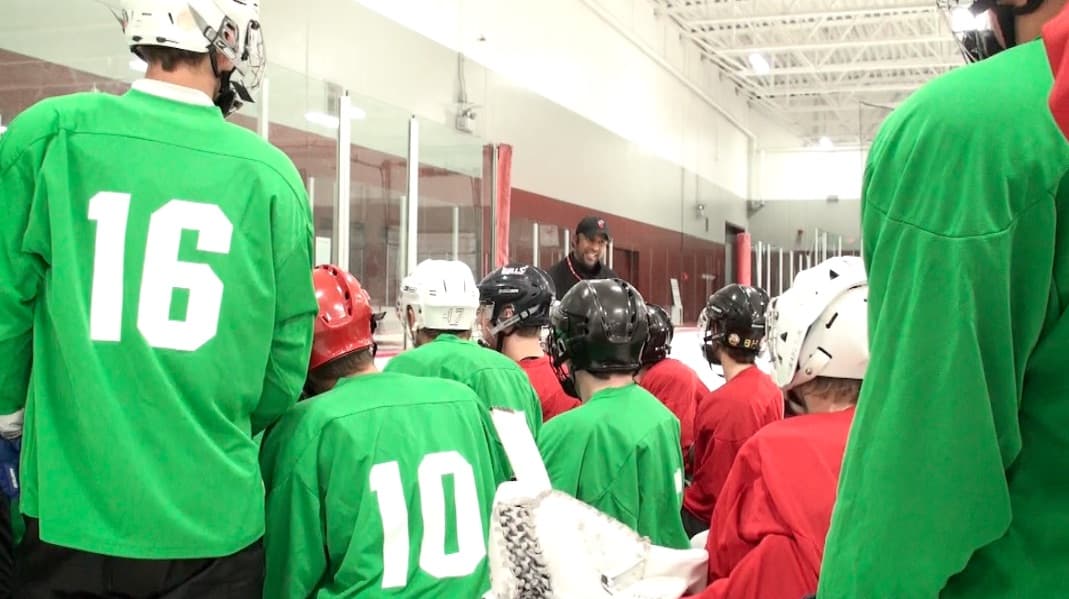
Brad Perry coaching junior players at a showcase
The Conflicting Voices Problem
Hockey players collect coaches like equipment. By the time you are 16, you have had power skating coaches, skill coaches, head coaches, and assistant coaches, all telling you something slightly different. Some of it conflicts. Some of it is flat out wrong.
Most players handle this by picking a side. They decide which coach is right and they fight the rest. That is the mistake that ends careers before they start.
Why Players Push Back
It usually comes from a good place. A player learns something from a coach they respect and then a new coach says the opposite. The player feels like they are being asked to get worse.
I see it all the time when I ask a player to tuck the tongue of their skate under their shin pad for the first time. It gives them more ankle support. It is the right move. But it feels weird. So they fall on purpose. Not consciously. They just self-sabotage to prove it does not work. That is not about skating. That is about discomfort. And discomfort is not a reason to fight a coach.
The Career Reality Nobody Talks About
Here is what I figured out the hard way. I was playing for a coach who misunderstood a chip-off-the-glass breakout. He thought it was an even strength play. We were turning the puck over every shift. He was wrong.
I asked him once, quietly, if we could go tape-to-tape instead. He said no.
So I stayed after practice and worked the chip-off-the-glass by myself. Over and over. Got to where I could do it better than anyone on that team. He saw it. Sent me to the All-Star game. That All-Star game got me my next job.
If I had argued with him in front of the group, I am not sitting here right now.
The coach in front of you knows people. He played with someone, worked under someone, coached against someone. When your name comes up in a conversation you will never hear, and it will come up, what is he going to say? That you were the player who read his mind and executed? Or the one who fought him on everything?
What Adaptable Players Actually Do
The higher I climbed, the more I noticed something. The best players in any room could do whatever the coach asked and look like they had been doing it for years. First rep. Unfamiliar drill. Did not matter. Most of them were not doing it perfectly. They were doing it confidently. That is the difference.
Adaptable players are not better at the skill. They are better at committing to the attempt. They look like they belong because they act like they belong. And coaches gravitate toward those players. Always.
How to Get Something Out of Every Coach
Even if the coach is teaching something you think is junk, smart players are there for the workout. Put a pro player on the ice with a midget team doing a drill he has never seen. He will still get a great session in. He is not there to judge the drill. He is there to get better at something.
Find the one thing in every session you can add to your tool belt. Even if it is small. Even if you throw the rest away when you leave. You walk out better than you walked in, and the coach walks away thinking you are the most coachable player in the building. That reputation travels.
The Mindset Shift
Stop asking if this coach is right. Start asking how you become the best at what they are asking. Those are two completely different questions. The first one wastes energy. The second one builds careers.
Get comfortable being uncomfortable. That is not a soft skill. That is what separates players who make it from players who almost did.
Key Takeaways
- Stop arguing with coaches and start becoming the best at what they ask
- The coach in front of you knows people who can get you your next job
- Adaptable players are not better at the skill, they are better at committing to the attempt
- Find the one thing in every session you can add to your tool belt
Turn It Into Reps
Do not just read it. Put it into your game.
Start free, save the article, then use Ask Coach Brad when you want help turning the idea into a drill, a correction, or a plan for your next skate.
Keep Reading
Mindset · 6 min read
Stop Saying You Play Better with Better Players
Why this common excuse is holding you back. And the mindset shift that changed my game and can change yours.
Mindset · 6 min read
The Skill Nobody Teaches That Every Coach Notices
Why being the player who picks up the pucks, carries the water bottles, and does the job nobody asked you to do is the fastest way to get noticed by every coach in the building.
Mindset · 5 min read
Who Is That For?
Why players slam their sticks after mistakes, the defense mechanism nobody talks about, and how to break the cycle.