
How to Score on a Breakaway Every Time
Most players have one move and hope for the best. Here's why that doesn't work and what to do instead.
Save Your Place
Build a locker around what you are learning.
A free account lets you save articles, come back to your notes, and start asking better questions when something in your game keeps showing up.
A breakaway is one of the most exciting moments in hockey. You're behind the defense, it's just you and the goalie, and the entire rink is watching. It should be a goal almost every time. But most players blow it. And they blow it for the same reasons over and over again.
I've watched thousands of breakaways at every level from youth hockey to professional. The players who score consistently are not the ones with the fanciest moves. They're the ones who understand what's actually happening during that five-second window between getting the puck and getting to the goalie.
Why Most Breakaways Fail
The first thing most players do when they get a breakaway is get their feet wide and start to glide. The moment you do that, you start slowing down. And the moment you slow down, you give the back checker a chance to catch up and take away your shot. Your feet should be driving the entire time. The breakaway is not the time to coast.
The next thing they do is go to their one move. The move they always do. The one they practiced a hundred times in the driveway. The problem is that goalies see that move coming because most players telegraph it. Nobody ever taught these kids that they need 10 or more moves that they can execute in different situations. When you only have one option, the goalie only has one thing to prepare for.
The third mistake is the soft finish. A player will make a great move, beat the goalie completely, have an open net, and then take a soft shot that somehow gets stopped. You put in all that work to create the opportunity and then you don't finish it. When you beat the goalie, put it away. Hard. Don't admire the deke.
In the middle of a breakaway is not the time to try something you saw on TV last night. If you haven't practiced it hundreds of times, it doesn't exist in your game yet.
What You Should Actually Be Doing
From the moment you realize you have a breakaway, push the puck far enough ahead that you can get your eyes up and see the goaltender. You need to see what they're doing. Are they coming out aggressively? Are they sitting back? Are they cheating to one side? You cannot read any of that if your head is down staring at the puck on your stick.
Most players react at the last minute when the goalie comes out for a poke check. The shooter seems completely oblivious, like they didn't even know the goalie was there. That's because they were looking at the puck instead of the goalie. If your eyes are up, you see the poke check coming and you can adjust.
Watch for the goalie's skates too. Sometimes goalies will poke check your skate as you're coming through, not just your stick. That's something a lot of players don't think about until it happens to them.
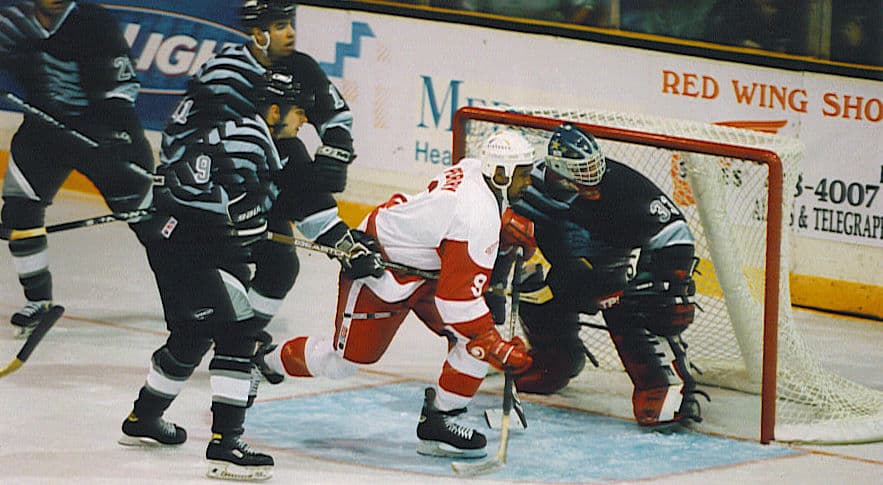
Brad Perry driving to the net during a game
The Score-First Mentality
This is the part that most players and parents don't want to hear. It's pretty important to understand where you are in the game as far as the score goes. If you're down or the game is close, your main objective on a breakaway is to score. Not to look good. Not to try the move you've been working on. To score. And you can't score if you make a move and the puck pops off your stick.
I've never been angry about shooting the puck on a breakaway. I'm still angry about every deke I tried where the puck popped off my stick and I never got an opportunity to help the team.
There's a time to try things. Practice is that time. A meaningless shift in a blowout game is that time. But when the game is on the line and you have a breakaway, the smart play is usually the one with the highest percentage of going in. A hard, well-placed shot beats a fancy deke that doesn't work nine times out of ten.
The best breakaway scorers I've played with and coached all had the same approach. They read the goalie on the way in, picked the highest percentage option based on what the goalie gave them, and executed with confidence. No hesitation. No second-guessing. They trusted their preparation.
Building Your Arsenal
You need to practice breakaway situations specifically. Not just dekes in a drill line. Full speed, coming in from the neutral zone, with a goalie in the net. You need to practice reading the goalie's position, adjusting your approach on the fly, and finishing under pressure. And you need at least 10 moves that you can pull from without thinking.
That sounds like a lot, but it's really not. A forehand shot, a backhand shot, a five-hole shot, a forehand-to-backhand deke, a backhand-to-forehand deke, a toe drag, a fake shot to deke, a straight speed play where you blow past the goalie's poke check, a far-side shot off the rush, and a change of speed move. That's 10 right there. Practice each one until it's automatic and your brain will pick the right one in the moment.
I'll be breaking down each of these moves in detail with video so you can see exactly what they look like at full speed. Check out the video section for the breakaway breakdown series as it goes live.
Key Takeaways
- Keep your feet driving. The moment you glide, you slow down and the back checker catches up.
- Eyes up. Push the puck ahead so you can read the goalie instead of staring at your stick.
- Have 10+ moves ready. One go-to move is not enough at any level.
- Score first, deke second. A hard shot on net is better than a fancy move that doesn't work.
- Practice breakaways specifically. Full speed, with a goalie, reading and reacting.
Turn It Into Reps
Do not just read it. Put it into your game.
Start free, save the article, then use Ask Coach Brad when you want help turning the idea into a drill, a correction, or a plan for your next skate.
Keep Reading
Skill Drills · 6 min read
The Never Look at the Puck Myth
Every coach says it. Nobody actually teaches you how to do it. Here's what I tell my players instead.
Skills · 6 min read
Every Hockey Skills Video Is Wrong
I've watched almost every hockey video out there, and every one has something wrong in it. Here's the mistake nobody talks about, why cradling the puck is costing your player, and how to actually get better.
Mindset · 5 min read
The Coach You Hate Might Be the One Who Gets You Your Next Job
Why adaptability is the most underrated skill in hockey. And how the coach standing in front of you right now might be the one who gets you your next job.