
The Skill Nobody Teaches That Every Coach Notices
Why being the player who picks up the pucks, carries the water bottles, and does the job nobody asked you to do is the fastest way to get noticed by every coach in the building.
Save Your Place
Build a locker around what you are learning.
A free account lets you save articles, come back to your notes, and start asking better questions when something in your game keeps showing up.
My stepdad Jack White was my first skills coach. But he was also one of the higher ups at Hanna-Barbera, the company that drew the Flintstones, the Jetsons, and a lot of the cartoons you grew up watching. He ran a successful hockey skills camp in the Los Angeles area. He was a good hockey player, a technical advisor on movies most of which you have seen, and a lifelong student of the game.
What made Jack different was that he didn't just do one job. On a movie set he wasn't just the technical advisor, the person who works with the director to make sure the hockey scenes feel real. Because he was an animator, he also handled the storyboarding, which most productions use to draw out what scenes will look like before they shoot. He handled communication with the equipment companies too. He was doing the job of three people in one. And that made him invaluable to Disney, Warner Brothers, and every other production company that hired him.
There were other people who could do the technical advising job. But nobody else could do all three.
I've carried that lesson with me my entire career.
What This Looks Like on the Ice
I just helped coach a development camp with kids from 7 to 11. One kid named Ethan didn't particularly stand out during the drills. Not bad, not great. But when it came time to get off the ice because the Zamboni was coming out, I looked over and Ethan was on a knee picking up pucks and putting them in the bucket. It was Ethan and all of the coaches. Nobody asked him to do it. He wasn't doing it to get noticed. He was just being helpful.
Every coach on that ice knows his name now. That may not seem like a big deal, but it is.
It's not just picking up pucks. It's picking up trash as you walk by it in your home rink. It's going out to help with the younger teams when you don't have to. It's being the player who carries the water bottles without being asked and genuinely cares about the people around them.
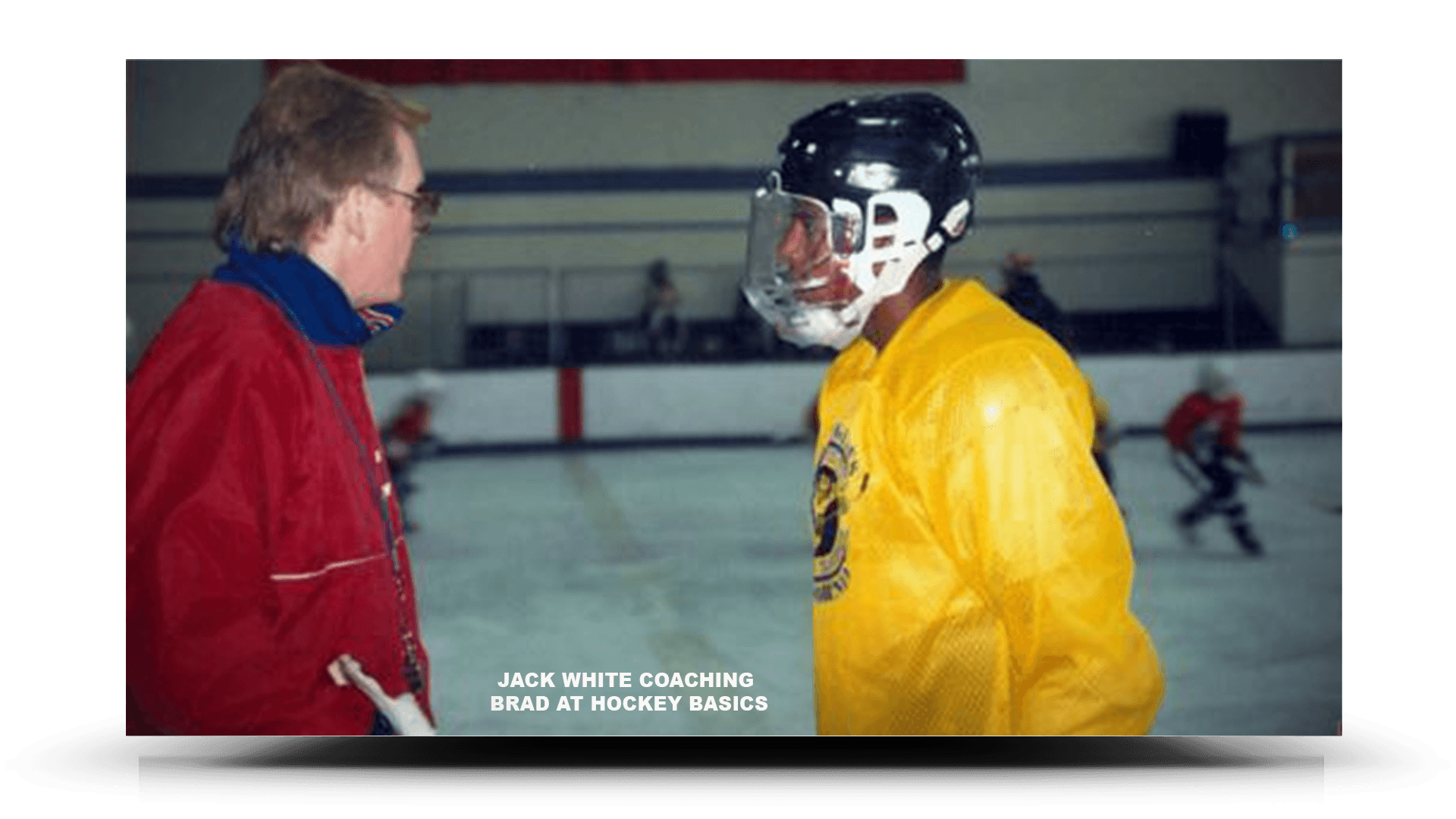
Jack White coaching young Brad Perry at Hockey Basics
Where You See It and Where You Don't
In certain parts of North America, this is baked into the culture. Minnesota, Wisconsin, North Dakota, Vancouver, Toronto (all places I played). Something about the environment in those places teaches players these habits young. You see more kids coming out to help, volunteering with younger programs, treating the rink like it belongs to them.
That's typically why you see it more at the junior level. Those are the kids junior coaches get to choose from. And once you've been around long enough you can tell who they are. If I'm a coach trying to keep my job, I need players I can count on both on and off the ice. These types of players are reliable, consistent, and they make it so I don't have to worry about moving my family again.
At the youth level, it's rarer. Not because the kids are bad. Because nobody taught them yet.
What Happened When I Stopped Playing
I had been traveling around the country with a hockey school for 11 years. I was recently married and ready to start a family. I came into the local rink thinking I would be welcomed with open arms. I had played professionally. I had coached at camps all over the country. But they already had people and didn't need any more. One coach in particular was very upset that I was there and wanted me out of the building.
That was the moment it clicked. Nobody cares what you did somewhere else. They care what you can do for them right now.
I was very appreciative of the people who did let me stay and opened the doors in the morning for me to do lessons. I bought them gift cards to say thank you and was genuinely interested in them and their families. That went a long way.
But I also realized I needed to do more than just teach hockey. At my last skills position I was able to do lessons every morning because I created graphic designs, built seven websites for the company, and took over all of their IT for three facilities in the city (all self taught). I didn't go to school for any of that. I learned it because it needed to be done and it made me more valuable to the team.
Can You Teach This?
It's actually very difficult to teach someone to be this way if it isn't instinctual. Most of the players who do it have either grown up around it or were taught at a young age. Sometimes they're just born with it.
If I have to tell you to help, that's usually not who you are. But it can be a learned trait as long as you're doing it to genuinely be helpful. People can always spot someone who's trying to trick them. The line between being valuable and being a kiss-up is simple. If you're doing it so someone sees you do it, that's fake. If you're doing it because it needs to be done, that's real.
The Takeaway
Trying to find opportunities to be more valuable to your team is one of the most underrated skills in hockey. I never realized how common it was at the higher levels until I got there. It was almost nonexistent in youth hockey, but it's everywhere once you get to junior and beyond.
You don't need to be the best player on the ice to be the most valuable person in the building. Sometimes the kid on a knee picking up pucks is the one every coach remembers.
Key Takeaways
- Be the player who picks up pucks, carries water bottles, and helps without being asked
- Coaches remember the player who makes their life easier, not just the most skilled one
- Make yourself valuable beyond your position: the more you can do, the harder you are to replace
- If you're doing it so someone sees you, it's fake. If you're doing it because it needs to be done, it's real
Turn It Into Reps
Do not just read it. Put it into your game.
Start free, save the article, then use Ask Coach Brad when you want help turning the idea into a drill, a correction, or a plan for your next skate.
Keep Reading
Mindset · 5 min read
The Coach You Hate Might Be the One Who Gets You Your Next Job
Why adaptability is the most underrated skill in hockey. And how the coach standing in front of you right now might be the one who gets you your next job.
Mindset · 6 min read
Stop Saying You Play Better with Better Players
Why this common excuse is holding you back. And the mindset shift that changed my game and can change yours.
Mindset · 5 min read
Who Is That For?
Why players slam their sticks after mistakes, the defense mechanism nobody talks about, and how to break the cycle.