
Who Is That For?
Why players slam their sticks after mistakes, the defense mechanism nobody talks about, and how to break the cycle.
Save Your Place
Build a locker around what you are learning.
A free account lets you save articles, come back to your notes, and start asking better questions when something in your game keeps showing up.
Over the years I've coached thousands of kids. And one of the patterns you see over and over is the inevitable temper tantrum. A player messes something up, might not even be a big deal, and suddenly they're slamming their stick, shooting the puck against the glass, kicking a water bottle. Full meltdown.
It usually starts early in our training time together. The player is new to me and wants to make a good impression. We're doing a basic drill just to figure out where they are and get used to my style. They make a small mistake, sometimes barely noticeable. And then, without any rhyme or reason, they lose it.
I know exactly what this is. So I stop them and ask one question. Who is that for?
The Defense Mechanism Nobody Talks About
Nobody likes getting yelled at. In hockey, it's a rite of passage to go through those embarrassing experiences as a younger player. Most coaches at those levels misinterpret what coaching is supposed to be and they command respect by demanding it. Sometimes players really hate this interaction and they don't have any recourse. The parents think it's making the kid tougher. The coach feels like he's scaring respect into the rest of the team.
What ends up happening is the tantrum becomes a defense mechanism. When that kid is slamming his stick and throwing a fit, what he's really saying is: Hey Coach, I'm angrier at myself than you could ever be. There's no need for you to yell at me because I'm already beating myself up about it.
I know this is what's happening because I went through it. I didn't throw temper tantrums, but it was confusing and aggravating, mostly because all I really wanted was for the coach to tell me how to do the thing.
What I Tell the Player
You're here with me right now to learn. If you make a mistake, I'm here to teach you how to make it better. You getting angry instead of thinking about how to fix it is wasting both of our time.
In the amount of time it took you to slam your stick and cry and get angry, you and I both could've come up with a solution. Right now you don't even know what you did wrong or how to fix it.
Then I show them the video. And we work on it slowly, controlled, piece by piece.
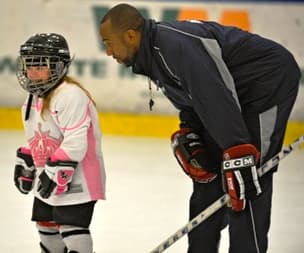
Brad Perry coaching a young player on the ice
Does It Actually Stop?
It varies. Some players understand pretty quickly that I'm not going to yell and they feel more comfortable, especially because I'm explaining what's happening rather than punishing them for it. Others take months if I have the opportunity to work with them that long. Sometimes it's just so ingrained that it's hard to let go.
It does eventually go away while we're working together because they start to understand that we'll get it at some point. And I make sure that when that moment happens, the moment they do it right, they see it on video and they're completely aware of it. Those wins tend to stack up pretty quickly.
I always try to ask them: explain what you did wrong. Don't waste time being angry. In that same amount of time that you were slamming your stick and losing your mind, you could've actually come up with a solution on your own. Or at least done it better the next time.
What Parents Should Do
If you're in the stands watching your kid slam their stick, you need to have an honest conversation about what they think they're going to gain from it. Especially nowadays when sticks can be upwards of $400.
No coach that your kid is trying out for has ever seen a player slam their stick and said "that's the kid I want, the one who's getting angry over a simple mistake."
You can use the NHL as a reference. Out of hundreds of games, I almost never see that. Tell your player to do what the pros do. Except the fighting part, of course.
Key Takeaways
- The tantrum is a defense mechanism: the player is trying to punish themselves before the coach can
- In the time it takes to slam a stick, you could have figured out what went wrong and fixed it
- Show them the video. Let them see the mistake clearly, then work through it piece by piece
- Ask your kid: what do you think you're going to gain from slamming your stick?
Turn It Into Reps
Do not just read it. Put it into your game.
Start free, save the article, then use Ask Coach Brad when you want help turning the idea into a drill, a correction, or a plan for your next skate.
Keep Reading
Mindset · 5 min read
The Coach You Hate Might Be the One Who Gets You Your Next Job
Why adaptability is the most underrated skill in hockey. And how the coach standing in front of you right now might be the one who gets you your next job.
Mindset · 6 min read
Stop Saying You Play Better with Better Players
Why this common excuse is holding you back. And the mindset shift that changed my game and can change yours.
Mindset · 6 min read
The Skill Nobody Teaches That Every Coach Notices
Why being the player who picks up the pucks, carries the water bottles, and does the job nobody asked you to do is the fastest way to get noticed by every coach in the building.