
Hockey Players Train Like Musicians
I taught myself guitar. I taught myself hockey. The process was identical. Here's the method that actually works and why most players skip the only part that matters.
Save Your Place
Build a locker around what you are learning.
A free account lets you save articles, come back to your notes, and start asking better questions when something in your game keeps showing up.
I taught myself to play guitar. No instructor, no structured lessons, just me figuring it out the hard way. And the longer I played, the more I realized I'd been doing the same thing on the ice my whole career without ever having a name for it.
I also played trumpet in junior high. Jazz band and orchestra. Yeah, I was that guy. I was sitting second or third chair and I wanted first. I knew what that required. I had to be deliberate about what I practiced, how I practiced it, and why. That mentality carried into hockey, and eventually I started to see the two worlds weren't all that different.
The Chord Change Rule
When you're learning to move from chord to chord on a guitar, you don't start at full speed. You slow it down until the transition is clean. What you're chasing isn't speed, it's smoothness. You want that chord change to feel natural even when it's slow, and then gradually you find the tempo where it starts to break down. That's where you live for a while. You practice right at the edge of your control until that edge moves forward.
Hockey skills work exactly the same way.
Breaking It Into Chunks
Say you're a right wing and you want to work on getting around a defender at the blue line. You start with the fake, a front fake where you sell the inside and then escape to the wall, keeping the puck on your forehand, faking to the backhand and pulling it back. That's chunk one. You do it until it's clean, until you're not losing the puck and the fake actually looks like something a defender would bite on.
Then you stack chunk two. You add the crossovers after the escape, building the speed you gave up when you made the move, driving toward the net. Fake, escape, crossovers. Still not worrying about the finish.
Then you add chunk three. Shot placement, reading the lane, deciding whether you're driving the front or wrapping to the backhand side to avoid a hit. Three separate pieces, broken apart and then put back together.
Once you have it on your strong side you flip it. Now the same sequence from the left wing position, backhand to forehand, escaping back out to the backhand with crossovers, alternating between a forehand and backhand finish. You're not just learning one move, you're building the habit of breaking things apart and stacking them back together.
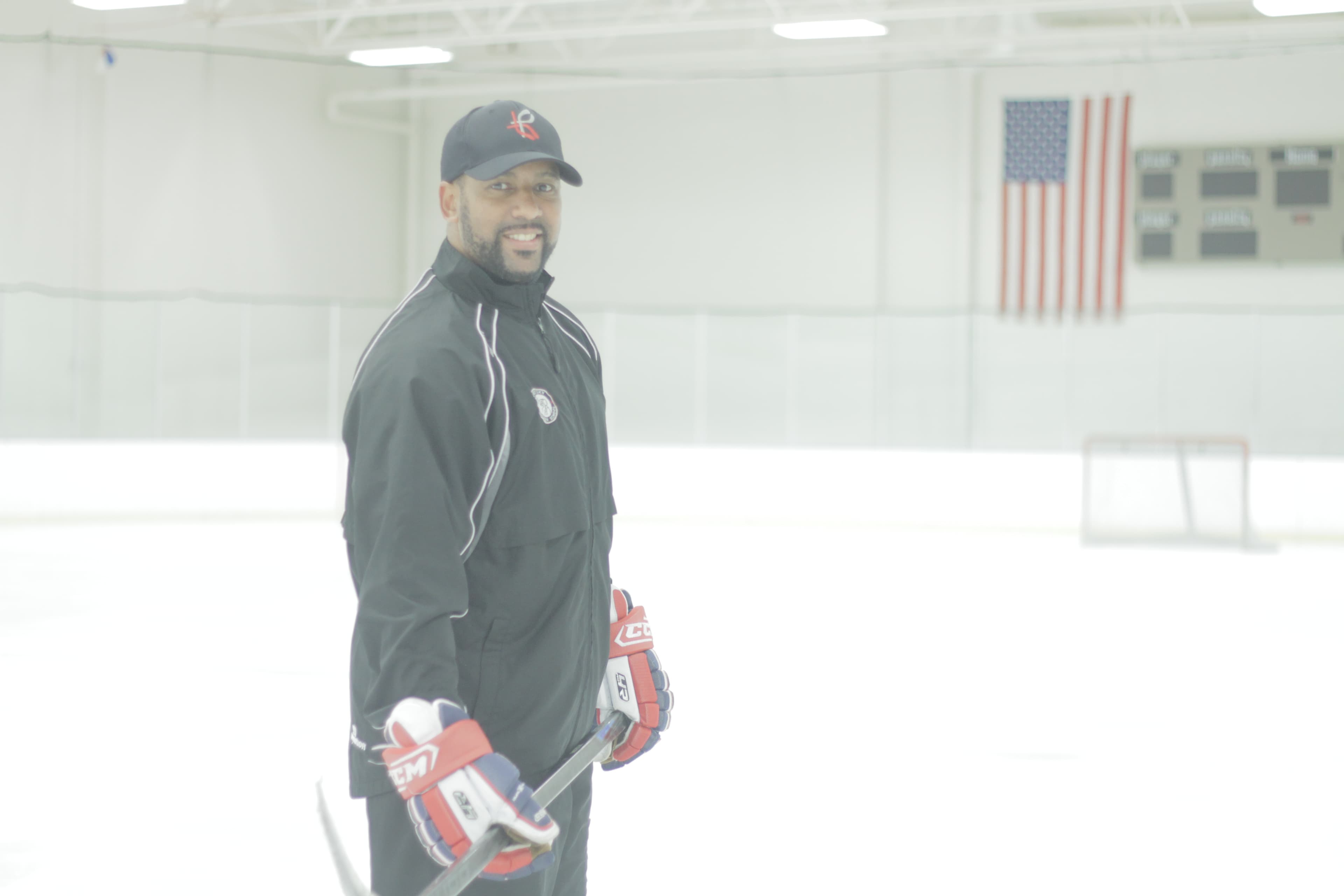
Brad Perry coaching on ice
The Compulsive Part
You have to be a little compulsive about it. You have to be stubborn enough to stay with a chunk until it's actually working, not until you're bored with it, but until it's clean. Then you move on and repeat. The finished product you're building toward has to live clearly in your head the whole time so you know what you're stacking toward and when each piece is actually ready.
Most players practice at the speed they can already do things, which means they never push the edge of their ability forward. They get comfortable in what works and call that development.
From Competing to Playing Together
Through all of my amateur hockey, I was competing against my own teammates. I wanted to move up to the first line. A bad weekend and I was back on the third. A good stretch and I was back up. Everyone around me was my competition and I was theirs. That's just how it worked at that level.
When I got to junior hockey, something changed. My role was defined. The coach had expectations and I knew what they were. My linemates knew theirs. There was a comfort in that I hadn't felt before, because I wasn't trying to outperform the guy next to me anymore. I was trying to work with him.
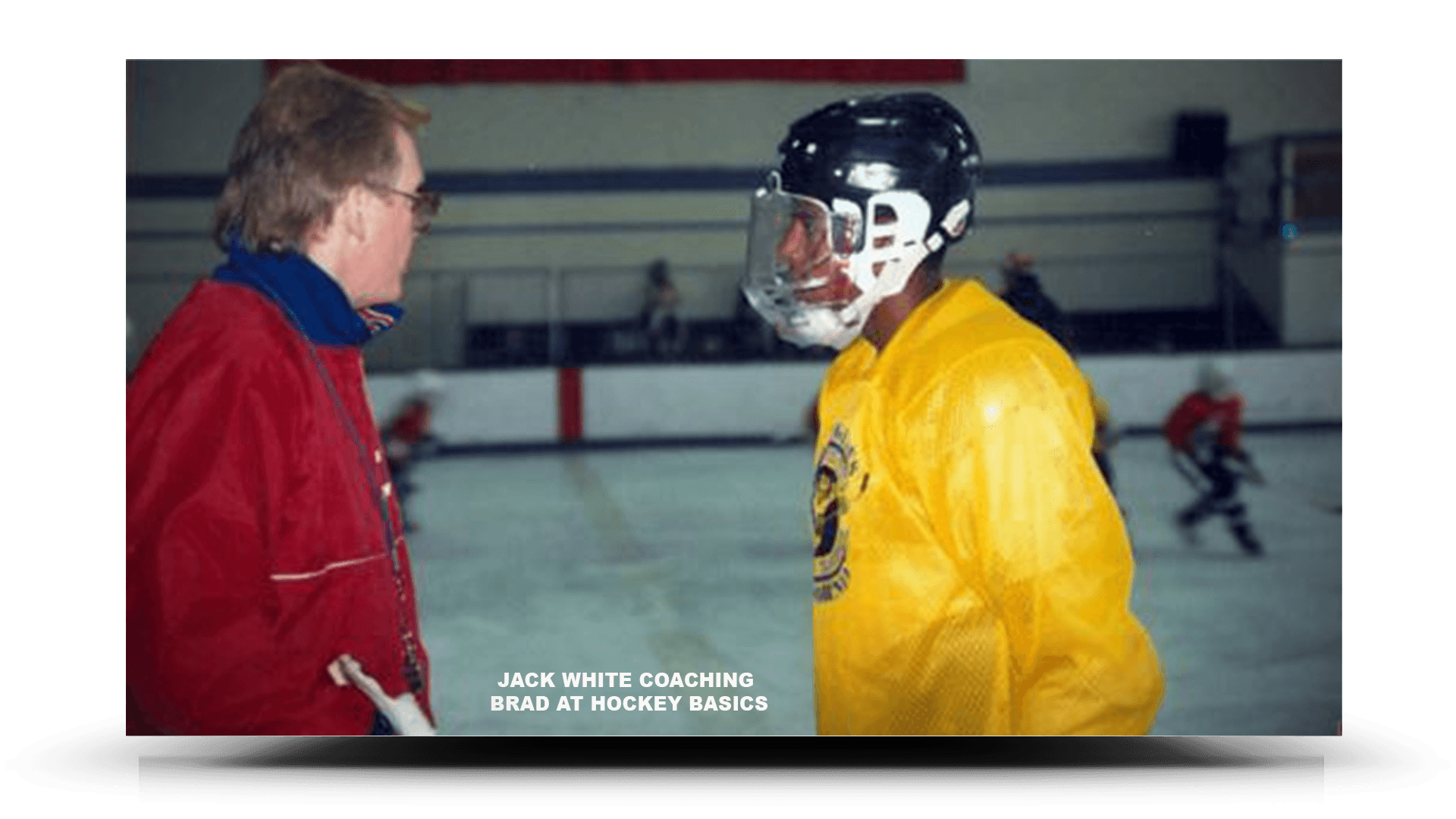
Jack White coaching Brad Perry
It felt like being in a band.
The conversations on the bench were different. Instead of thinking about how many points I needed, we were talking through plays. Next shift, when you're heading down the wall in that situation, I'll swing around the back of the net and call for it. Or, I'll set a pick and you take the shot. Those conversations didn't exist at the amateur level. Nobody was thinking that way because everyone was still fighting for their own spot.
Once I understood my role and trusted that I was safe in it, I stopped competing against my teammates and started actually playing with them. That's when hockey started feeling like music. We were building something together instead of trying to outrun each other.
Don't Worry About Them
If you're a player still deep in AAA and you're spending energy worrying about the guy next to you, here's what I'd tell you: don't. There are so many things at that level that don't matter, and most of what you're stressing about is in that category. The only thing that matters is whether you're improving. Learning how to recognize your mistakes and then actually use those corrections at full speed in a game, that's the job.
The best players on any team don't worry about the competition from their teammates. They set the bar. That's who you should be trying to become. Not someone who keeps up with the room, someone who raises it.
The musicians who become elite aren't the ones who play loudest. They're the ones who do the work nobody sees, slowly, deliberately, one chunk at a time, until the whole thing comes together and sounds effortless.
That's hockey too.
Key Takeaways
- Slow the skill down until it's smooth, then find the edge of your control. That's where you practice.
- Break complex moves into chunks, master each one, then stack them back together.
- You have to be stubborn enough to stay with a chunk until it's actually clean, not just until you're bored.
- The shift from competing against teammates to playing with them is one of the biggest mental jumps in hockey.
- Don't worry about the guy next to you. Set the bar. The players who make it raise the room.
Turn It Into Reps
Do not just read it. Put it into your game.
Start free, save the article, then use Ask Coach Brad when you want help turning the idea into a drill, a correction, or a plan for your next skate.
Keep Reading
Skills · 6 min read
Every Hockey Skills Video Is Wrong
I've watched almost every hockey video out there, and every one has something wrong in it. Here's the mistake nobody talks about, why cradling the puck is costing your player, and how to actually get better.
Mindset · 5 min read
The Coach You Hate Might Be the One Who Gets You Your Next Job
Why adaptability is the most underrated skill in hockey. And how the coach standing in front of you right now might be the one who gets you your next job.
Mindset · 6 min read
Stop Saying You Play Better with Better Players
Why this common excuse is holding you back. And the mindset shift that changed my game and can change yours.