
Coming Back from Mistakes
Every player at every level makes mistakes. The question isn't whether you'll make them. The question is what you do in the seconds right after.
Save Your Place
Build a locker around what you are learning.
A free account lets you save articles, come back to your notes, and start asking better questions when something in your game keeps showing up.
Every player at every level makes mistakes. It doesn't matter how good you are, how long you've been playing, or what level you're competing at. Mistakes are part of the game. The question isn't whether you'll make them. The question is what you do in the seconds right after.
That skill, rebounding from a mistake quickly and cleanly, is one of the hardest things to master in hockey. Most players never really do.
The Band Analogy
If you've ever been to a live concert and watched a band play, you've probably seen a moment where the drummer catches the eye of the bass player and they share a quick laugh. It lasts half a second. Somebody messed up. Maybe a missed cue, a dropped beat, the wrong chord. But as the audience, you have no idea. They didn't stop. They didn't react. They just kept making music.
That's the model.
In hockey, every player on the ice makes mistakes every single game. Even the best ones. The difference between those players and everyone else is that when they mess up, they don't skip a beat. They read the situation, recover, and keep playing. Sometimes it goes completely unnoticed. Especially when they do something great on the very next play.
Other players cough up the puck and immediately you see the stick slam. The hands go up. They stop skating for a second and complain to no one. What was just a mistake that nobody may have noticed is now the most visible thing that happened that shift.
Those players do it in practice. They do it in games. It becomes part of how the room sees them.
How to Process It
When a mistake happens in a game, the right move is to start processing it immediately. Not to dwell on it, but to make a quick mental note of what happened and what you would've done differently. A split second of self-coaching and then you're back into the play. The bus ride home or the car ride back is where you actually work through it. You think about the situation, what it looked like, and what the better version of that play would have been. Then at night, before you go to sleep, you go through it again.
You visualize the situation in detail, different angles, slightly different variations of the same moment, and you see yourself doing it right. If you have ice time coming up and can build a drill around it, you do that too. That process is real growth. It's disciplined, it's mature, and it works.
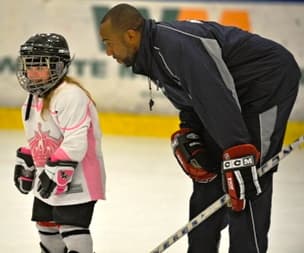
Brad Perry coaching youth hockey players
One-Off vs. Consistent Problem
There's a difference between a one-off mistake and a consistent problem. You almost always know when you've made a mistake that cost something real. A turnover that led to a goal. A missed coverage that gave up a shot. You feel those. But the more important question is whether it's becoming a pattern.
When a coach takes the time to pull you aside and mention something, that's your signal. By the time a coach says it to you, they've already seen it in several situations. They've been watching. They took the time to walk over and bring it up. Most players don't take it seriously because they think it was just one mistake or they don't believe it really applies to them. That's a mistake bigger than whatever the coach saw on the ice.
When a coach mentions something to you, immediately start doing the exact opposite of that thing. In a big way. Squash the label before it sets.
How Labels Spread
When a label does set, here's what happens. A coach says something to a player. Another player overhears it. Parents find out somehow. And suddenly the whole organization knows you as the player who doesn't do a certain thing. You might have no idea any of it is happening. But people in the stands are talking about it, coaches from other teams hear it, and it follows you. The player almost never knows how far it's traveled.
The only answer is to keep your ears open, treat everything as information, and fix things quickly and visibly.
Get Physical
There are going to be stretches where you're in a slump. Your game isn't working. You're not generating offense, you're not making the plays you know you can make, and you can't figure out why. In those moments, the easiest thing you can do is get physical.
Anybody can throw their weight around. Anybody can hit, dig, and work the corners. It doesn't require skill, it doesn't require the puck to bounce your way, and it's almost always appreciated. Playing physical contributes. It wakes your team up, it changes the momentum of a shift, and it tells your coach you're still working even when things aren't going your way. Just be smart about it. Stay out of the penalty box. Don't chase hits late and give up easy power plays. Channel the physicality into something that helps.
I dealt with a version of this most of my career. I started playing hockey late, which meant my positioning was weak for a long time. I knew it. Coaches saw it. I couldn't walk up and ask someone to fix it without drawing attention to the exact thing I was trying to hide. So I earned my way around it. When I was scoring, coaches were willing to overlook the gaps. When I wasn't, I leaned into the physical game, the energy game, whatever kept me useful until I could get back to contributing the way I wanted to.
Mistakes happen. Every game. Every level. What matters is whether you react like the drummer who keeps playing or the player who stops the whole song to tell everybody what just went wrong.
Keep playing. Fix it after.
Key Takeaways
- You can't avoid mistakes. How hard you skate to recover from them is completely within your control.
- Process mistakes quickly in-game, work through them on the ride home, visualize the fix at bedtime.
- When a coach mentions something to you, they've already seen it multiple times. Squash it immediately and overcorrect.
- Labels spread further than you know. Keep your ears open and fix things fast and visibly.
- When nothing is working, get physical. Anybody can hit, dig, and work the corners.
Turn It Into Reps
Do not just read it. Put it into your game.
Start free, save the article, then use Ask Coach Brad when you want help turning the idea into a drill, a correction, or a plan for your next skate.
Keep Reading
Mindset · 5 min read
The Coach You Hate Might Be the One Who Gets You Your Next Job
Why adaptability is the most underrated skill in hockey. And how the coach standing in front of you right now might be the one who gets you your next job.
Mindset · 6 min read
Stop Saying You Play Better with Better Players
Why this common excuse is holding you back. And the mindset shift that changed my game and can change yours.
Mindset · 6 min read
The Skill Nobody Teaches That Every Coach Notices
Why being the player who picks up the pucks, carries the water bottles, and does the job nobody asked you to do is the fastest way to get noticed by every coach in the building.